
Who's involved
- Microsoft
- It makes the Copilot answer engine and Bing.
- Its own representative data holds the click-through rate figures, and its own executive wrote the documents. It is a defendant, and it says those documents are not the company's view.
- OpenAI
- The company that makes ChatGPT.
- It is the other defendant. Its own head of ChatGPT wrote that publishers face an existential threat from products like its own.
- The New York Times Company
- The company that publishes The New York Times newspaper.
- It leads the news organizations suing the two companies. Its websites carry the 87 to 93 percent band in Microsoft's data.
- Ziff Davis
- A digital media company whose brands include CNET, PCMag, IGN, ZDNET, Everyday Health and Mashable.
- It is one of the five plaintiff groups. Its websites carry the widest band in the same data, 51 to 94 percent.
- Brent Hecht
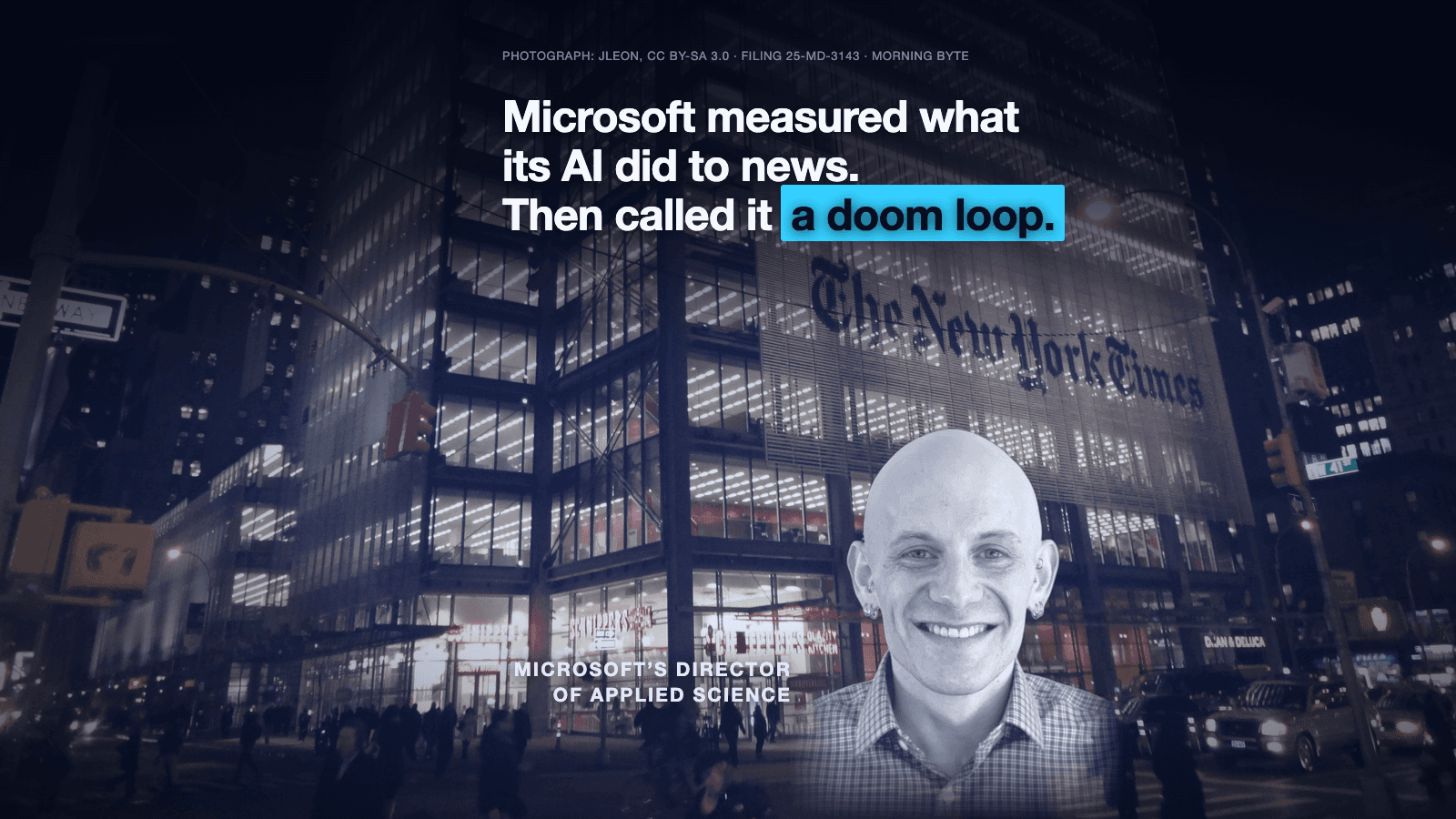
- A Microsoft executive, its Director of Applied Science and a Partner at the company.
- He wrote several internal Microsoft documents the brief quotes, including the doom loop passage. Microsoft now calls them one employee's individual perspective.



What changed
On September 17 a motion for summary judgment became public. It belongs to the copyright case The New York Times Company brought against OpenAI and Microsoft three years ago. It quotes internal documents both firms had fought to keep confidential. In one, Microsoft recognized that “millions of people around the world will soon consider large models ‘hoovering up’ all their work to be an astonishing theft of unprecedented proportions.” That is a forecast about what other people will think. It is not a confession. The same document admitted that “almost no one intended for content they created to be used in this fashion.”
Microsoft's click figures are rates, not counts, and the difference is the whole thing. A click-through rate is the share of clicks a web address gets against its total impressions. The brief counts an impression whether that address appears in a list of search results or inside a chatbot's answer. So a falling rate means a smaller share of the times you are shown, not a counted number of readers who stopped arriving.
Microsoft's representative data puts that rate reduction at 87 to 93 percent for the Times' websites. For the Daily News papers, eight local newspapers including the Chicago Tribune and the Denver Post, it is 83 to 91 percent. For the websites of Ziff Davis the range is 51 to 94 percent. Ziff Davis is a digital media company whose brands include CNET, PCMag, IGN and Mashable. The comparison in every case is Bing Chat against Bing Web Search.
One Microsoft document put the problem in a single sentence. It opens: “Our AI content strategy has started a ‘doom loop’ that will hurt the performance of our models and the entire web at the same time.” The sentence continues after a colon. “It is highly unusual that an end-product threatens the economic foundations of its essential suppliers, but that is the situation we have created for our LLM business with respect to its ‘content supply chain.’”
Microsoft disputes how its own papers are being read. Brent Hecht is the Microsoft executive who wrote them, as the brief describes him. A company spokesperson told Ars Technica, a technology news site that read the filing, that his documents “reflect one employee's individual perspective, are not a legal analysis, and do not represent the company's views.”
What's at Stake
The reduction in click-through rate for The New York Times' websites in Microsoft's own representative data, comparing Bing Chat with Bing Web Search.
Market intelligence
The read: Over five years, Microsoft is up 67.2%, The New York Times Company is up 20.5% and Ziff Davis is down 53.9%. Over one year, Microsoft is down 2.1%, The New York Times Company is up 6.4% and Ziff Davis is up 53.9%. Over the past month, Microsoft is up, The New York Times Company is down and Ziff Davis is up. Microsoft is up 0.5% today, ahead of the S&P 500's −0.8%. The New York Times Company is down 5.4% today, behind the S&P 500's −0.8%. Ziff Davis is down 1.3% today, behind the S&P 500's −0.8%.
OpenAI and Brent Hecht don't trade on a stock market.
Prices move for many reasons. This shows where they stand, not what caused it.
Prices: Yahoo Finance.
How We Got Here
- The internal warning
TechCrunch, a technology news site, dates to this month the internal Microsoft memo in which Brent Hecht set out what he expected people to make of large models taking their work.
- The doom loop presentation
TechCrunch dates to this month the Microsoft presentation by Hecht describing the decline in click-through rates as a doom loop.
- The brief becomes public
A less redacted version of the news plaintiffs' combined summary judgment brief is filed on the public docket, carrying the quotations and the rate figures.
Why it matters
Here is the machine in plain words. A search result is a signpost. It names a page and sends the reader to it, and the site that wrote the page gets the visit, the advertising and the chance at a subscription. An answer engine is not a signpost. It reads the page and tells the reader what it says, on its own screen.
Microsoft's chief executive Satya Nadella agreed under oath with a statement put to him. Conversing with chatbots, it said, “has substituted … giving you the information right there on the website on the AI platform versus needing to go to the underlying source.” Microsoft disputes the weight of that too. Its spokesperson said the testimony touched on “broad principles” and was made of “observations” that “should not be confused with conclusions about copyright questions before the Court.”
The people building it did not think better link placement would fix it. An OpenAI software engineer wrote that “no matter how prominently we show the links, users won't click.” Nick Turley, who runs ChatGPT at OpenAI, wrote that publishers face an “existential threat,” and said of his own company's products that they “are largely substitutive, period.”
Two figures in the filing carry further than the rest. Among surveyed Times subscribers who used or paid for ChatGPT for news, 36 percent said it “means I no longer need news from the New York Times at all.” The other is about the whole web. The brief lists Cloudflare among companies that connect publishers with AI firms, and Cloudflare's chief executive cited data on pages scraped for every visitor sent back. In 2015 Google's search engine took two pages for every visitor it returned. By June 2025 that was eighteen to one for Google, and fifteen hundred to one for OpenAI.
That is why this reaches past journalism. Any business that depends on people arriving from a search box sits where these publishers sit. The useful part is not the argument about whether an answer engine changes that traffic. It is that the company which built one measured the change for the sites in this case, and wrote the number down.
Who's Accountable

He wrote several internal Microsoft papers the brief quotes. One says Microsoft's AI content strategy started a doom loop. Microsoft now calls his papers one employee's view.
Photograph: Brent Hecht, from his own site brenthecht.comWhat to watch
Nothing here is decided. This is a motion asking a judge to rule, filed by one side. Much of the new material comes from the plaintiffs' brief rather than from the underlying exhibits, which remain sealed. TechCrunch, which read the same filing, states plainly that the quotes it published appear without their original context. Microsoft disputes what its own documents are taken to mean, and OpenAI did not answer either outlet's request for comment.
The legal weather has not favored the publishers so far. TechCrunch reports that judges have been largely favorable to the argument that training an AI model on copyrighted work is fair use. It also reports that the Trump administration filed a brief this month defending OpenAI's unlicensed use of copyrighted material for training.
There is one thing a reader can do this week that does not wait on a judge. The filing cites a study finding that 87.78 percent of ChatGPT users visit no external website during a search, against 26.91 percent of Google users. Open your own traffic records and find the share of your visits that still arrives from a search box. Whatever yours turns out to be, you now know it is a number worth having.
Reader comments
Not signed in yet — hit Post and we'll finish it together