
What changed
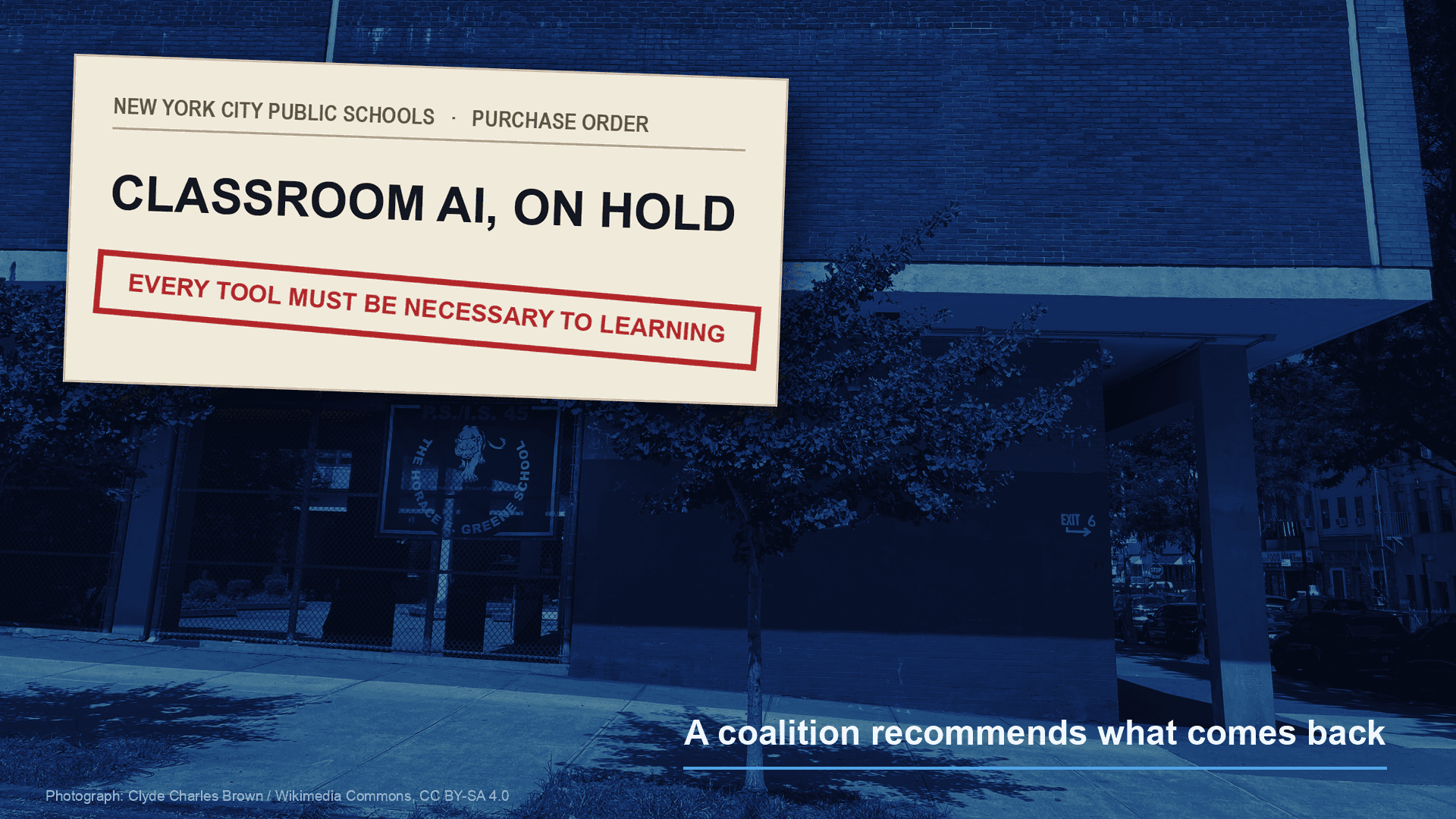
New York City schools opened this week under a new rule. Students cannot use generative AI in class this school year, from the district's youngest grades through eighth grade, the range the release labels 2-K through 8th. That is nearly 600,000 children, about two thirds of the district. Mayor Zohran Mamdani and Chancellor Kamar Samuels announced the pause on September 2. Companion chatbots, the kind built for company rather than schoolwork, are barred in every grade, including high school.
The policy carries exceptions. The release grants them for assistive technology usage by students with disabilities, multilingual learners, and students in career readiness programs like computer science. It does not describe how a family asks for one. The adults in the building keep more room than the students. Teachers may still use AI for lesson planning and operational work that meets city safety standards.
The larger change is one sentence about buying. Every technology tool the district uses now faces an exhaustive review, and anything the review does not find mission-critical to learning gets barred. Mission-critical is the city's phrase for necessary to learning. That is a purchasing test, and it reaches far past products with AI in the name. The district already told principals in July to pause software purchases while it finished the policy, ABC7 New York reported.
High school is where AI still appears in ordinary classes, and narrowly. Five limited pilots reach at most 50,000 students in general education classes, about 5 percent of the student body. No high school runs more than five of those classes. Every high schooler will also have access to two 45-minute literacy modules a year, covering bias, risk, ethics and what AI does to careers.
What's at Stake
Children in 2-K through eighth grade, paused for one school year
Students who may use a vetted AI pilot
How We Got Here
- 2025-2026 school yearPhones go
A bell-to-bell ban on personal internet-enabled devices takes effect.
- March 2026Earlier guidance
It carries no grade-based AI limits and no device limits.
- July 2026Purchases pause
Principals are told to pause software purchases.
- September 2, 2026The moratorium
AI paused through eighth grade, and every tool faces review.
- 2026-27 school yearThe coalition reports
A year of study, then recommendations for what returns.
The System Underneath
Principals were told to pause buying in July, then the city wrote one test every classroom tool must clear, and a coalition now studies the year and recommends what returns.
The People
- Principals told to pause buyingSoftware purchases paused while the policy is written
- then the city writesThe mission-critical reviewEvery technology tool has to clear itand separately picksFive limited pilotsAt most 50,000 high schoolers
- so the year goes toTechnology in Schools CoalitionStudents, educators, parents, unions, experts
- which it recommendsWhat returns to the classroomRecommendations for future school years
So the thing to watch is the coalition's report, not the end of the ban.
Why it matters
The reason this reaches past New York is the purchasing test. The district wrote down a bar that every technology tool has to clear, and the bar is not about AI. It asks whether a tool is necessary to learning at all. The review weighs vendor accountability for safety and transparency, ethics, evidence of learning design, instructional impact, prior research, and user feedback collected continuously.
That matters if you own a piece of an education-software company, directly or through a fund. Nearly 600,000 students sit behind this pause, about two thirds of the district. The city told principals to pause software purchases while the administration finished its policy. So when a company you hold talks about school revenue, there is now a question to ask. Which side of a necessary-to-learning review does its product sit on?
The five pilot tools are not the answer to that question. The release says they were selected on safety and data privacy standards, teacher-guided instruction, and keeping students the primary thinker in the classroom. Quill is designed to support close reading and using evidence in English classes, at no more than 15 minutes a week. Edia is designed to coach math step by step, at no more than 20 minutes a week. It also prompts students to explain their reasoning.
Brisk Teaching is designed to give guided practice on texts a teacher selects. The release puts Brisk Boost at 10 to 20 minutes, once or twice a week. Playlab is designed to have students examine AI outputs for bias, on no more than two assignments a marking period. Intel AI-Ready Schools is designed to help students identify community problems and develop AI solutions through semester-long projects, one period a week.
For a parent rather than an investor, the change is concrete. Companion chatbots are out in every grade. Screens are limited too. One-to-one device use, meaning one screen per child, is restricted through second grade, with recommended daily caps of 30 minutes in grades three to five and 45 minutes in grades six to eight.
Who's Accountable

Announced a one-year student AI pause through eighth grade. Said AI in early education is not inevitable.
The tech industry wants us to believe that A.I.-powered early education is not only inevitable, but necessary. We do not see it that way.Photograph: NYC Mayor's Office
What to watch
What shapes next year is not the end of the moratorium. It is the report written while the moratorium runs. A Technology in Schools Coalition spends the year assessing the pause and the pilots. Its members include students, educators, parent leaders, elected officials, advocates, union partners and experts. It then publishes recommendations.
The two clocks do not match. The release puts one year on the moratorium and no term at all on the review beside it. The pause has an end date. The purchasing bar does not.
The release does not list industry among the coalition's members. It does carry Julie Samuels, president and chief executive of Tech:NYC, saying she serves on the task force and recommending that high schoolers' access be expanded beyond one hour per week. Whether that task force is the coalition, the release never says.
The discovery here is not the ban. A school system told its principals to pause software purchases in July, then published the test every product will have to pass. The pause is the headline. The sentence about buying is the policy, and it outlives the year.
Reader comments
Not signed in yet — hit Post and we'll finish it together